

If you have ever generated a hash for a file, password, API value, or piece of data, you have probably seen algorithms such as MD5, SHA-256, and SHA-512. They all turn input data into a fixed-length string, but they are not equally secure or suitable for the same jobs.
The biggest mistake is treating every hash algorithm as interchangeable. MD5 is considered broken for collision-resistant security applications, while SHA-256 and SHA-512 belong to the SHA-2 family and remain widely used for secure hashing. (RFC Editor)
In this guide, we will compare MD5 vs SHA-256 vs SHA-512, explain how hashing works, look at their key differences, and help you understand which option makes sense for common development tasks.
MD5 vs SHA-256 vs SHA-512: Quick Answer
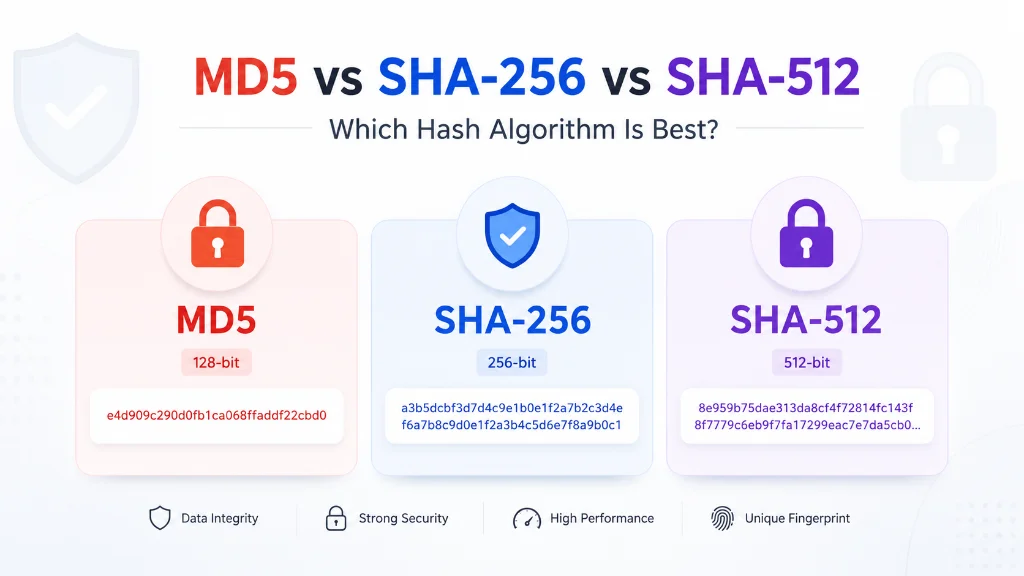
MD5, SHA-256, and SHA-512 are cryptographic hash algorithms that convert data into fixed-length digital fingerprints. MD5 produces a 128-bit hash and is no longer suitable when collision resistance is required. SHA-256 produces a 256-bit hash, while SHA-512 produces a 512-bit hash. For most modern applications requiring secure hashing, SHA-256 is a practical default. (RFC Editor)
| Algorithm | Hash Length | Family | Modern Security | Common Use |
|---|---|---|---|---|
| MD5 | 128 bits | MD family | Not suitable for collision-resistant security | Legacy checksums, non-security error detection |
| SHA-256 | 256 bits | SHA-2 | Strong modern choice | Integrity, signatures, certificates, blockchain, applications |
| SHA-512 | 512 bits | SHA-2 | Strong modern choice | High-security applications, large-scale cryptographic systems |
The important takeaway is simple: do not choose MD5 for new security-sensitive applications. SHA-256 is generally the easier default when you need a modern cryptographic hash. NIST lists SHA-256 and SHA-512 among the SHA-2 algorithms specified in FIPS 180-4. (NIST Computer Security Resource Center)
What Is a Hash Algorithm?
A hash algorithm takes input data of arbitrary length and produces a fixed-length output called a hash, digest, or message digest.
For example, imagine you have this text:
Hello WorldA hashing algorithm processes the text and produces something similar to:
a591a6d40bf420404a011733cfb7b190d62c65bf0bcda32b...The important characteristic is that even though the input can be extremely large, the output size remains fixed for a particular algorithm.
NIST defines a hash function as a function that maps a bit string of arbitrary length to a fixed-length bit string. Important security properties include collision resistance, preimage resistance, and second-preimage resistance. (NIST Computer Security Resource Center)
Hashing Is Not Encryption
This distinction is critical.
Encryption is designed to protect information so that authorized users can decrypt it and recover the original data.
Hashing is designed to create a fingerprint of data. A properly designed cryptographic hash is intended to make it computationally infeasible to reverse the hash and recover the original input.
Think of it like this:
| Feature | Hashing | Encryption |
|---|---|---|
| Main purpose | Create a data fingerprint | Protect readable data |
| Reversible? | Designed to be one-way | Yes, with the correct key |
| Fixed output size? | Usually yes | Depends on algorithm/mode |
| Uses a key? | Basic hash does not | Usually |
| Example | SHA-256 | AES |
This is why you should not say that SHA-256 "encrypts" a file. SHA-256 hashes the file.
How Does Cryptographic Hashing Work?
At a high level, hashing follows a straightforward process:
1. You provide input data.
2. The algorithm processes the input through multiple mathematical operations.
3. The input is divided and processed internally.
4. The algorithm produces a fixed-length digest.
5. You can compare that digest with another digest to determine whether the data matches.
For example, suppose you download a large software file.
- The developer can publish a SHA-256 hash alongside the download.
- You calculate the SHA-256 hash of your downloaded file.
- If both hashes match, the file contents are consistent with the data used to generate the published hash.
NIST describes secure hash algorithms as tools for generating message digests that can help detect whether messages have changed since the digest was generated. (NIST Computer Security Resource Center)
A Small Change Creates a Different Hash
One useful property of cryptographic hashing is the avalanche effect.
Changing even a tiny part of the input should produce a dramatically different output.
For example:
- Input A:
Hello World - Input B:
Hello world
Only the capitalization of one character changed, but the resulting hashes will be completely different.
This makes cryptographic hashes useful for detecting unexpected changes in files and data.
What Is MD5?
MD5 stands for Message-Digest Algorithm 5. It was designed by Ronald Rivest and published as RFC 1321 in 1992. MD5 produces a 128-bit message digest. (RFC Editor)
For many years, MD5 was widely used for checksums, file verification, and various software applications because it was relatively simple and fast.
The problem is that cryptographic research eventually demonstrated practical collision attacks against MD5.
A collision occurs when two different inputs produce the same hash.
For security applications where collision resistance matters, this is a serious weakness.
RFC 6151 states that MD5 is no longer acceptable where collision resistance is required, including applications such as digital signatures. (RFC Editor)
Should You Still Use MD5?
For new security-sensitive software, no.
MD5 may still appear in legacy systems or in situations where the hash is being used only as a basic error-detection checksum rather than a security mechanism. RFC 6151 specifically notes that MD5 can still be acceptable for certain checksum uses where the purpose is solely to protect against accidental errors. (RFC Editor)
However, developers should not confuse a checksum with cryptographic security.
Rule of thumb:
If an attacker could intentionally manipulate the data, do not rely on MD5 for security.
What Is SHA-256?
SHA-256 is part of the SHA-2 family of cryptographic hash algorithms.
It produces a 256-bit hash, which is twice the output size of MD5's 128-bit digest.
SHA-256 is widely used in modern software and security systems for tasks such as:
- File integrity verification
- Digital signatures
- Certificates
- Security protocols
- Blockchain systems
- Data integrity checks
- Content identification
- Cryptographic applications
NIST's Secure Hash Standard includes SHA-256 and SHA-512 as members of the SHA-2 family. NIST also recommends SHA-2 or SHA-3 as modern alternatives in applications that require secure hash functions. (NIST Computer Security Resource Center)
Why Is SHA-256 So Popular?
SHA-256 offers a useful balance between security, compatibility, output size, and performance.
For many developers, that makes it the obvious starting point when a project requires a general-purpose cryptographic hash.
If you are unsure whether you need SHA-256 or SHA-512, SHA-256 is often the simpler choice unless your application has a specific reason to use the larger digest.
What Is SHA-512?
SHA-512 is another member of the SHA-2 family.
As its name suggests, it produces a 512-bit hash, giving it a larger output than SHA-256.
Like SHA-256, SHA-512 is included in NIST's Secure Hash Standard. (NIST Computer Security Resource Center)
A SHA-512 digest contains 512 bits, which is commonly represented as 128 hexadecimal characters.
By comparison:
- MD5 = 128 bits = 32 hexadecimal characters
- SHA-256 = 256 bits = 64 hexadecimal characters
- SHA-512 = 512 bits = 128 hexadecimal characters
The larger output does not automatically mean that SHA-512 is "twice as secure" as SHA-256 in every practical situation.
Hash security depends on the specific security property being considered and how the algorithm is used.
MD5 vs SHA-256 vs SHA-512 Hash Length
Hash length is one of the easiest differences to understand.
| Algorithm | Bits | Hexadecimal Characters |
|---|---|---|
| MD5 | 128 | 32 |
| SHA-256 | 256 | 64 |
| SHA-512 | 512 | 128 |
A longer digest provides a larger output space and can provide stronger theoretical resistance against certain brute-force collision strategies.
However, longer does not automatically mean better for every application.
If an application only needs a standard modern cryptographic hash, SHA-256 can be more than sufficient.
MD5 vs SHA-256: Key Differences
The biggest difference between MD5 and SHA-256 is their current security status.
MD5 was designed decades ago and has known collision weaknesses. SHA-256 belongs to the SHA-2 family and is approved by NIST for secure hashing applications. (RFC Editor)
| Factor | MD5 | SHA-256 |
|---|---|---|
| Output | 128-bit | 256-bit |
| Security status | Broken for collision resistance | Modern secure hash |
| Speed | Generally fast | Generally fast enough for most applications |
| Legacy support | Very high | Very high |
| New security projects | Avoid | Recommended choice |
| File integrity | Legacy/non-adversarial use | Stronger choice |
| Digital signatures | Not suitable | Suitable as part of a signature system |
If you are choosing between only MD5 and SHA-256 for a new project, SHA-256 is the clear choice when security matters.
SHA-256 vs SHA-512: Which Should You Choose?
SHA-256 and SHA-512 are both members of the SHA-2 family, so this comparison is more nuanced.
SHA-512 creates a larger digest, while SHA-256 creates a shorter digest that is easier to store, transmit, and display.
Your decision should depend on your application requirements rather than simply choosing the algorithm with the bigger number.
Choose SHA-256 When:
- You need a general-purpose secure hash.
- You want a shorter digest.
- Compatibility is important.
- You are designing a typical web or software application.
- You need a strong default without a specific SHA-512 requirement.
Choose SHA-512 When:
- Your application specifically benefits from a 512-bit digest.
- Your security design requires the larger hash output.
- Your platform or protocol specifies SHA-512.
- You have a documented reason to prefer SHA-512 over SHA-256.
Do not choose SHA-512 simply because 512 is bigger than 256. Bigger output is useful in some situations, but algorithm selection should always start with the security requirements of the application.
Practical Example: Verifying a Downloaded File
One of the easiest ways to understand hashing is through file verification.
Imagine a software developer publishes:
software.zip SHA-256: abc123...xyz789You download the file and calculate its SHA-256 hash.
If your calculated digest matches the published digest, you have evidence that the file contents match the data represented by that published hash.
This is why a Hash Generator can be useful during development, troubleshooting, and file verification.
You can use the TechbyJeel Tools Hash Generator to generate hashes from supported input and compare the resulting digest with a known value.
For image-related workflows, you can also use the Image Compressor, while developers working with structured data may find the JSON Formatter useful alongside hashing and data-validation tasks.
Is SHA-512 More Secure Than SHA-256?
Not necessarily in the simple sense of "twice as secure."
SHA-256 produces a 256-bit digest, while SHA-512 produces a 512-bit digest. Both belong to the SHA-2 family and are designed for cryptographic hashing.
The larger SHA-512 output provides a larger hash space, but security is not determined only by the number in the algorithm's name. Your application, threat model, implementation, and security requirements all matter.
For most everyday development tasks, SHA-256 provides an excellent balance between security and practicality.
MD5 vs SHA-256 vs SHA-512: Security Comparison
Security is the most important factor when choosing a cryptographic hash.
| Security Factor | MD5 | SHA-256 | SHA-512 |
|---|---|---|---|
| Hash size | 128-bit | 256-bit | 512-bit |
| Collision resistance | Broken | Strong | Strong |
| Suitable for new security applications | No | Yes | Yes |
| SHA-2 family | No | Yes | Yes |
| File integrity | Limited/legacy | Excellent choice | Excellent choice |
| Digital signature applications | Not recommended | Common | Common |
| General-purpose hashing | Legacy only | Recommended | Recommended when appropriate |
The critical difference is collision resistance.
A collision happens when two different inputs produce the same hash. MD5 has demonstrated practical collision weaknesses, which is why it should not be used where attackers could deliberately exploit collisions.
SHA-256 and SHA-512 do not have the same practical collision weaknesses known for MD5 and remain widely used for modern cryptographic applications.
What Is a Hash Collision?
A hash collision occurs when:
Input A → Hash X
Input B → Hash X
Even though Input A and Input B are different, they produce the same digest.
This matters because many security systems assume that a cryptographic hash acts as a reliable fingerprint of data.
If attackers can deliberately create two different files with the same hash, they may be able to undermine systems that rely on that hash for authentication, signing, or verification.
That is one of the major reasons MD5 should not be used for security-sensitive applications.
Are SHA-256 and SHA-512 Safe for Passwords?
This is where many beginners make a serious mistake.
A general-purpose hash such as SHA-256 or SHA-512 should not normally be used directly to store user passwords.
Password storage requires algorithms specifically designed to make password guessing expensive.
Modern password-storage approaches commonly use dedicated password hashing functions such as:
- Argon2
- bcrypt
- scrypt
- PBKDF2
The goal is different from ordinary file hashing.
For file integrity, you generally want hashing to be efficient.
For password storage, you want password guessing to be deliberately expensive.
Why Fast Hashing Is Bad for Passwords
Suppose an attacker steals a database containing password hashes.
If passwords were processed using a fast algorithm, the attacker could potentially test huge numbers of password guesses quickly.
A password hashing algorithm deliberately adds computational work and often memory requirements to make large-scale guessing more expensive.
So:
> Use SHA-256 or SHA-512 for appropriate cryptographic hashing tasks, but use a dedicated password hashing algorithm for password storage.
This distinction is extremely important for developers building authentication systems.
MD5 vs SHA-256 vs SHA-512 for File Integrity
File integrity is one of the most common practical hashing use cases.
Imagine a developer publishes a 2 GB software package. Instead of asking users to compare every byte manually, the developer can publish a cryptographic hash.
The user calculates the hash of the downloaded file.
If the values match, the file contents correspond to the published digest.
Which Algorithm Is Best for File Integrity?
For new projects, SHA-256 is usually the easiest general-purpose choice.
SHA-512 is also a strong option when your project specifies it or benefits from the larger digest.
MD5 can still appear in older software and basic non-adversarial checksum scenarios, but it should not be treated as a modern security mechanism.
You can generate a digest using the TechbyJeel Tools Hash Generator and compare it with a known hash value.
Hashing in Real-World Applications
Hash algorithms appear in many areas of software development.
1. File Verification
Software distributors can publish a SHA-256 or SHA-512 checksum so users can verify downloaded files.
2. Digital Signatures
Hash functions are commonly used as part of digital-signature systems. Instead of signing an entire large message directly, systems can use a digest as part of the signing process.
3. Certificates and Security Protocols
Modern security infrastructure uses cryptographic hashing as part of certificate and authentication systems.
4. Blockchain
Hash functions are an important building block in many blockchain systems and related cryptographic structures.
5. Data Integrity
Applications can calculate hashes to detect whether stored or transmitted data has changed.
6. Content Identification
Some systems use hashes as identifiers or fingerprints for data, although the exact algorithm and design depend on the application.
SHA-256 vs SHA-512: Performance
Performance is another factor worth considering.
It is tempting to assume:
- SHA-256 = smaller = always faster
- SHA-512 = larger = always slower
That is too simplistic.
Actual performance depends on the processor architecture, implementation, programming language, libraries, input size, and hardware acceleration available.
On some 64-bit systems, SHA-512 can perform surprisingly well because its internal operations are designed around 64-bit words.
Therefore, do not choose SHA-256 or SHA-512 based purely on assumptions about speed.
If performance is critical, benchmark the actual implementation on the hardware and data sizes your application will use.
For most normal web applications, file verification tasks, and developer tools, the security and compatibility requirements are usually more important than small performance differences.
Common Hashing Mistakes Developers Make
Mistake 1: Using MD5 for Security
MD5 is fast and widely supported, but that does not make it secure.
Fix: Use SHA-256 or another modern cryptographic hash when collision resistance is required.
Mistake 2: Calling Hashing Encryption
A hash is not simply another type of encryption.
Fix: Use the term "hash" or "digest" when discussing cryptographic hashing.
Mistake 3: Using SHA-256 Directly for Passwords
SHA-256 is a general-purpose cryptographic hash, not a password-storage algorithm.
Fix: Use Argon2, bcrypt, scrypt, or PBKDF2 according to your application's requirements.
Mistake 4: Assuming SHA-512 Is Always Better
A bigger digest does not automatically make it the best choice for every project.
Fix: Choose based on your actual security and compatibility requirements.
Mistake 5: Ignoring the Threat Model
A checksum designed only to detect accidental corruption has different requirements from a hash used against an active attacker.
Fix: Ask what you are protecting and what an attacker could realistically do.
Which Hash Algorithm Should You Choose?
Use this simple decision guide.
| Your Requirement | Recommended Choice |
|---|---|
| New general-purpose cryptographic hashing | SHA-256 |
| Larger SHA-2 digest required | SHA-512 |
| Modern file integrity verification | SHA-256 or SHA-512 |
| Legacy checksum with no security requirement | MD5 may exist in legacy systems |
| Password storage | Argon2, bcrypt, scrypt, or PBKDF2 |
| New security-sensitive application | Avoid MD5 |
| Protocol specifically requiring SHA-256 | SHA-256 |
| Protocol specifically requiring SHA-512 | SHA-512 |
The Simple Rule
If you are starting a new project and someone simply asks:
> "Which hash should I use?"
A reasonable starting point is:
- Use SHA-256 unless your application's requirements specifically call for another algorithm.
- If your protocol, security architecture, or platform specifies SHA-512, use SHA-512.
- Do not select MD5 for new security-sensitive functionality.
MD5 vs SHA-256 vs SHA-512: Final Verdict
So, which is the best?
There is no universal winner, but for most modern development projects, SHA-256 is the best general-purpose default.
MD5 is primarily a legacy option and should not be used when collision resistance or security is important. SHA-256 and SHA-512 are modern SHA-2 algorithms, with the right choice depending on your application's requirements.
If you are building a tool, verifying files, or working with cryptographic data, focus on the actual security requirement instead of simply choosing the algorithm with the largest number.
- MD5: Legacy and unsuitable for security-sensitive collision-resistant applications.
- SHA-256: Strong, practical, and an excellent general-purpose choice.
- SHA-512: Strong, larger digest, and useful when the application specifically benefits from it.
Key Takeaways
- MD5 produces a 128-bit hash and has known collision weaknesses.
- SHA-256 produces a 256-bit hash and is a strong general-purpose choice.
- SHA-512 produces a 512-bit hash and is another strong SHA-2 option.
- A longer hash does not automatically mean it is the correct choice.
- Never use general-purpose hashes as a substitute for password hashing algorithms.
- For most new projects, SHA-256 is a practical default.
- Always consider your application's threat model and technical requirements.
If you work with hashes regularly, keep the purpose of the hash in mind first. File integrity, password storage, digital signatures, checksums, and data identification can require very different approaches.
Try the Free Hash Generator
Need to calculate a hash quickly?
Use the TechbyJeel Tools Hash Generator to generate hashes directly in your browser and compare different hash outputs.
You can also explore other free developer utilities such as the JSON Formatter or browse more tools on TechbyJeel Tools for everyday development and productivity tasks.
Conclusion
MD5 vs SHA-256 vs SHA-512 is not simply a competition between three numbers. MD5 has important collision weaknesses, while SHA-256 and SHA-512 remain widely used members of the SHA-2 family.
For most modern applications requiring a general-purpose cryptographic hash, SHA-256 is a strong and practical starting point. SHA-512 is also an excellent choice when its larger digest or specific protocol requirements make it appropriate.
Choose the algorithm based on the job, not the biggest number. Try the free TechbyJeel Tools Hash Generator and explore more developer tools to simplify your daily workflow.
Frequently Asked Questions
Is SHA-256 better than MD5?
Yes, for security-sensitive applications, SHA-256 is a much better choice than MD5. MD5 has practical collision weaknesses and should not be relied upon where collision resistance is important. SHA-256 is part of the SHA-2 family and remains widely used for modern cryptographic hashing and data-integrity applications.
Is SHA-512 better than SHA-256?
Not automatically. SHA-512 produces a larger 512-bit digest, while SHA-256 produces a 256-bit digest. Both belong to SHA-2 and provide strong cryptographic hashing. SHA-256 is often a practical general-purpose choice, while SHA-512 can be appropriate when a larger digest or specific protocol requirement is needed.
Can SHA-256 be used for passwords?
SHA-256 should generally not be used directly for password storage. It is designed as a general-purpose cryptographic hash and is intentionally fast. Password storage should use a dedicated password hashing algorithm such as Argon2, bcrypt, scrypt, or PBKDF2, together with appropriate salts and security settings.
Is MD5 completely useless?
No, but its safe uses are limited. MD5 can still appear in legacy systems and certain non-security checksum scenarios where the goal is detecting accidental errors rather than resisting an attacker. It should not be used for new applications where collision resistance or cryptographic security is required.
Which hash algorithm should I use?
For many new applications that require a general-purpose cryptographic hash, SHA-256 is a sensible default. SHA-512 is also strong and may be appropriate when your protocol or security requirements call for it. Avoid MD5 for new security-sensitive functionality and never substitute general-purpose hashing for password hashing.